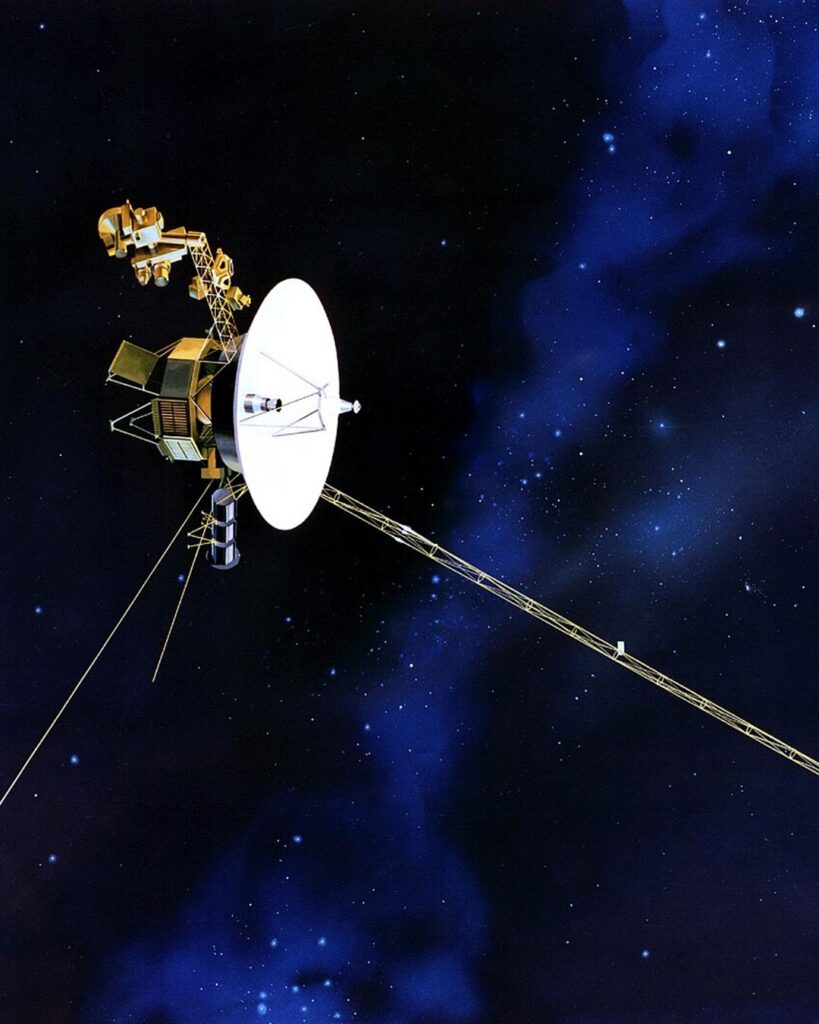
A spacecraft that left Earth in 1977 is about to go further than anything people have ever built. On 18 November, NASA’s Voyager 1 will be one full light-day away from Earth.
That means a radio signal, moving at the speed of light, will need a whole day to reach the probe. No human-made object has ever been that far from home.
How far is one light-day?
It is about 16.1 billion miles, or 25.9 billion kilometres. Light from the Sun reaches Earth in about eight minutes. At this distance, a message from Voyager 1 takes 24 hours to get here.
So when engineers send a command, they wait about two days for the answer: one day for the message to get there and one more for the reply to come back.
Voyager 1 is still moving at about 38,000 miles per hour, so the gap grows every second. Nothing special happens to the spacecraft when it crosses the line. It is a number on a map, but a very big one.
49 years on the road
Voyager 1 was launched in September 1977, the same year as its twin, Voyager 2. That is almost half a century in space, and it is still working.
In August 2012, Voyager 1 became the first spacecraft to leave the bubble of solar wind around our Sun and enter the space between the stars. It has been sending data back from there ever since.
Both probes carry a gold-plated record with sounds and pictures from Earth, made in case anyone out there ever finds them.
Running on very little power
The old probe gets its power from the heat of decaying plutonium, and that supply gets a little weaker every year. To keep it going, NASA has already switched off several of its science instruments.
Engineers still talk to it through the giant dish antennas of NASA’s Deep Space Network, with almost a full day of delay each way.
Our take
Voyager 1 was built with 1970s computers, and it is still talking to us from interstellar space. Most of our phones would not last five years.
On 18 November it will be a full day away at the speed of light. That is worth looking up at the night sky for.
What would you put on a golden record for aliens to find? Tell us in the comments.
Photos via Wikimedia Commons: artist’s view of the Voyager spacecraft by NASA/JPL (public domain); Voyager 1 launch on a Titan rocket in 1977 by NASA (public domain); cover of the Voyager golden record by NASA/JPL (public domain); a Voyager spacecraft being tested at JPL in 1976 by John Gregoire, NASA/JPL (public domain).
